like phrases written on water

After offering a convincing response when Kaso later challenged the validity of his awakening, Ikkyu went on to admit that he had practiced for a decade “seething with anger” only to find that as the raucous cawing of a crow shattered the evening’s silence “an enlightened disciple of the Buddha suddenly surfaced” from within the mud of his emotional torment.

Ikkyu continued practicing under Kaso for another four years, earning the deep respect of his master as well as a reputation for eccentricity. According to a biography completed by Ikkyu’s disciples not long after his death, when Kaso offered Ikkyu a “seal” of his enlightenment (inka) — a document essential for anyone seeking advancement in the Rinzai hierarchy — Ikkyu refused to accept it. Later discovering that Kaso had given the document to a laywoman for safekeeping, Ikkyu took possession of the inka, tore it to shreds, and asked his disciples to burn it. 

On another occasion, when Kaso was hosting a memorial ceremony for his own master, Ikkyu spurned the custom of wearing ceremonial raiment and showed up in patched robes and grass sandals, drawing the considerable ire of the rest of the community. Questioned by Kaso about his behavior, Ikkyu said that he was dressed simply, as a monk should be, while everyone else was prancing about in sumptuous “shit covers”. At the end of the service, when Kaso who was asked who would be his Dharma successor, he reportedly surveyed the gathering and said, perhaps with some reluctance, “the crazy one”.

…Ikkyu had devoted himself to Kaso precisely because he carried the torch of Daito’s personification of a “true person of no rank” — a rigorously ascetic approach to Zen exemplified by Daito having tempered his own enlightenment by living under a bridge with beggars and other outcasts for five years.


Peter Hershock


Having

realized understanding

kindness and the excellent nature

of opportunities and dangers, one ably

breaks through the net of doubts snaring all

sentient beings. Departing from ‘is’ and ‘is not’,

and other such bondages…leaping over quantity and

calculation, one is without obstruction in whatever

one does. With penetrating understanding of the

present situation and its informing patterns,

one’s actions are like the sky giving rise

to clouds: suddenly they exist, and

then they don’t. Not leaving

behind any obstructing

traces, they are like

phrases written

on water.
 

Ikkyu


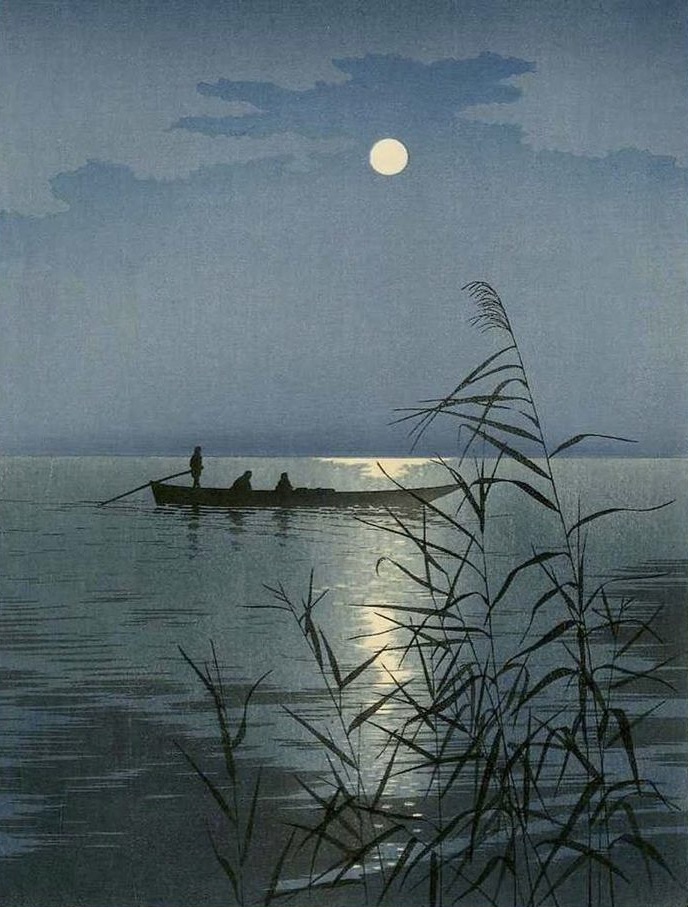
like the moon reflected in water

koho shoda


My teaching

which has come down

from the ancient Buddhas

is not dependent on meditation

(dhyana) or on diligent application

of any kind. When you attain the insight as

attained by the Buddha, you realize that Mind is

Buddha and Buddha is Mind, that Mind, Buddha,

sentient beings, Bodhi (enlightenment),

and Klesa (passions)  are of one and

the same substance while

they vary in names.


You should know that

your own mind−essence is neither subject

to annihilation nor eternally subsisting, is neither

pure nor defiled, that it remains perfectly undisturbed and

self−sufficient and the same with the wise and the ignorant, that it

is not limited in its working, and that it is not included in the

category of mind (citta), consciousness (manas), or

thought (vijnana). The three worlds of desire,

form, and no−form, and the six paths

of existence are no more than

manifestations of your

mind itself.


They are all like the moon

reflected in water or images in the

mirror. How can we speak of them as being

born or as passing away? When you come

to this understanding, you will be

furnished with all the things

you are in need of.

 
Shih−t’ou
 

the benefit of engagement in politics

only love can do that


Forget the self and you’ll help others.

Deshan Xuanjian


The spiritual benefit of engagement in politics comes from going into rather than away from the imperfection. And if you are diving right into the heart of delusion, naturally this means into the heart of your own delusion. There’s always a chance that such a plunge might increase self-knowledge more than it increases self-righteousness.

The point here is that you have to forget all that spiritual stuff about what a good person you are or intend to be someday, something that is anyway unlikely to be attained. The spirituality in politics might not be visible to others or even to yourself. Down there in the heart of delusion you look like a demon too, just like the rest of us. You’ll have to adapt your fashion sense to having horns and fangs.

This is the force of Bismarck’s famous comment about the art of the possible: in order to bring about any sort of transformation you have to work with what is actually the case, rather than what you might have wished for or pretended — in the world, in others, in yourself.

When I accepted how the world is, I noticed that empathy is part of how it is. It’s not easy to explain; it doesn’t have a reason. Empathy seems to be a basis for spiritual work — for the bodhisattva way. Empathy also doesn’t seem to be entirely personal. We didn’t work for change because we liked each other or the people who might benefit; there was empathy even when people were behaving in ways that I might find painful.


John Tarrant

bring me the rhinoceros