allow others their own path

what is called for now


It is not

our responsibility to

control or direct others.

Allow them their own path,

and keep to yours. If the

paths meet, fine. If

they do not,

also fine.


fifth changing line

The I Ching, or Book of Changes

Hexagram 32, Heng / Duration


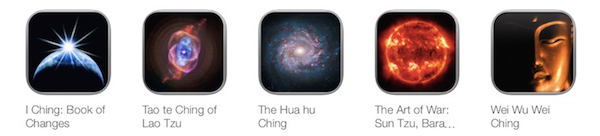
ebooks & apps of the Tao the Ching, I Ching,

Wei wu Wei Ching, Hua hu Ching, and

Art of War for iPad/Phone, Kindle,

Nook, or Android


You

can now buy

the I Ching as part of a

five-app bundle of Taoist classics 

for iPhone or iPad for less than

the cost of one hardcover

book.

brian browne walker taoist app bundle ios ipad iphone


promptly stop your search

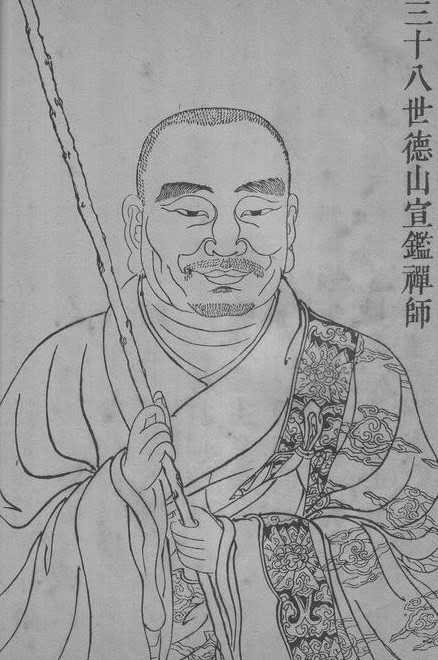
deshan xuanjian

 
If you can refrain from producing a single thought, you’ll be forever freed from birth and death, and will not be bound up by birth and death. You go when you want to go and sit when you want to sit — what further concern is there?

Don’t go crazy; I suggest to you that it would be better to stop and not be obsessed with anything. The moment a thought flashes through your mind, you’re a minion of the devil, an immoral worldling.

Just do not stick to sound and form externally, and do not conceive of subject and object internally. In essential being there is neither ordinary nor holy — what more would you learn? Even if you learn a hundred thousand marvelous doctrines, you’re just a sore-sucking ghost; it’s all mere fascination.

I do not mean to slander him about this, but this is why Buddha spewed out so much spittle of expedient means, to teach you to be free. Don’t search outside. As long as you don’t acquiesce, you want to collect unusual sayings and store them in your chest, so you can talk cleverly, getting by on glibness, hoping to be acknowledged by people as a Chan master, wanting to obtain a position of prominence.

If you entertain such views, someday you’ll go to hell where your tongue will be pulled out.

My perception is not that way. Here I have no Buddha and no Dharma. Bodhidharma was a smelly old foreigner, the bodhisattvas of the tenth stage are dung haulers, the equally and subtly enlightened are immoral worldlings, bodhi and nirvana are donkey-tethering stakes, the twelve-part canonical teachings are ghost tablets, paper for wiping pus from sores, those who have attained the four fruitions, the three ranks of sages, and those from initial inspiration to the tenth stage are ghosts haunting ancient tombs, unable to save even themselves. Buddha was an old foreigner, a piece of crap.

Good people, don’t make the mistake of putting on a garment of sores.

Here I have no doctrine at all to give you to interpret. I don’t understand Chan myself, and I am no teacher. I don’t understand anything at all, I just consume and excrete. What else is there?

I urge you to be free from concerns, promptly stopping your search; don’t learn aberration and madness. Everybody carries around a corpse, traveling, licking up the slaver of the old baldies wherever you go. Imbibing their drivel, you immediately proclaim that you are going into samadhi, cultivating capacities, accumulating good deeds to nurture the embryos of sagehood in hopes of fulfilling the realization of Buddhahood. This radiant void is unobstructed, free: it is not something you can attain by embellishment.

You are people of the present time; don’t seek somewhere else. Even if Bodhidharma were to come here, he would just tell you to be without affectations; he would tell you not to be contrived. Dressing, eating, excreting, there is no more “birth and death” to be feared, and no nirvana to be attained, no enlightenment to be realized. You’re just an ordinary individual, without affectations. 

Do you want to know? It’s just a void, with nothing to attain, pure and clear everywhere, radiant with light, thoroughly translucent inside and out. There is no affectation, no dependence, nothing to dwell on. What are you concerned with?
 

Deshan Xuanjian

treasury of the eye of true teaching
 

mastery over fear, doubt, anxiety

marcel van luit


Even the foolish

can attain wisdom by

modestly following

the Sage.

 
Folly is a characteristic of youth: those who have had little experience generally exhibit little wisdom. This is true of us in a spiritual way as well; in comparison to the Sage we are “babes in the woods.” The hexagram Mêng counsels us to utilize the I Ching as a lantern so that we may survive our youthful folly and travel safely through the woods of life.

There is no shame in seeking guidance in life. A child is eager to be shown the way by his parents and teachers, and we are wise to recognize that in spiritual terms we are akin to children. Our success will come quicker if we find and follow a wise teacher. The Sage is available to serve in this way for those who approach the I Ching with a sincere desire to learn and grow.

To study the I Ching is to gain the perspective of the Deity, to learn the cosmic lesson inherent in every situation that faces us. If we truly look for and strive to comprehend these larger lessons, we gain mastery over fear, doubt, and anxiety. We can learn from study of the I Ching to live in a state of understanding, contentment, and acceptance, but several things are required of us.

The first is that we suspend our mistrust of the Unknown and allow the Sage to lead us. It is tempting to think that the I Ching might be just a book, merely words on paper, but there is more to it that this. To accept this is to recognize the Sage and become receptive to his assistance.

The second thing required of us is that we quiet the demands of our egos for comprehensive answers to our questions about life. The I Ching teaches us not how to get from A to Z but how to get from A to B, then from B to C, then from C to D. The sage travels step by step, dealing always with what is immediately at hand and bringing complete focus and concentration to the moment. By doing the same we fall into step with, and receive the help of, the Creative power of the universe.

Lastly, we are required to unstructure our attitude. By abandoning strategies about people and situations, we let the past and future go and meet the present with an open mind. To be unstructured and open is to allow the Sage to guide us safely and joyfully through life.

The image of Mêng is that of a stream beginning to flow down a mountainside, filing each ravine and hollow place as it goes. If we persevere in following the Sage, seeking the counsel of the I Ching and filling in the gaps in our character as they are revealed, we will be led to lasting success in life.


The I Ching, or Book of Changes

Hexagram 4, Mêng / Youthful Folly


ebooks & apps of the Tao the Ching, I Ching,

Wei wu Wei Ching, Hua hu Ching, and

Art of War for iPad/Phone, Kindle,

Nook, or Android


You

can now buy

the I Ching as part of a

five-app bundle of Taoist classics 

for iPhone or iPad for less than

the cost of one hardcover

book.

brian browne walker taoist app bundle ios ipad iphone


the present moment is the source of everything

a moment of kindness


The

present moment

is the source of everything.

As long as you have resentments

about the past or ideas about

the future, you cannot

genuinely be in

the present.


You owe it

to your future self,

and to the rest of us, to be

completely absorbed here and

now. Make all notions of past

and future a cool pile

of ashes in the

corner.


Wei wu Wei Ching, Chapter 30

Paperback / Kindle here

iPad/iPhone

iBooks


brian browne walker taoist app bundle ios ipad iphone

You

can now buy

Wei wu Wei Ching as part of a

five-app bundle of Taoist classics 

for iPhone or iPad for less than

the cost of one hardcover

book.