
there is freedom at the end

those who awaken never rest


There is freedom

from desire and sorrow

at the end of the way. The awakened

one is free from all fetters and goes beyond

life and death. Like a swan that rises

from the water she moves onward,

never looking back.


The one who understands

the unreality of all things, and who

has laid up no store, that one’s track is

as of birds in the air. Like a bird in the air,

she takes an invisible course, wanting

nothing, storing nothing, knowing

the emptiness of all things.


Dhammapada


keep an open heart, free of desire

lee madgwick


An influence comes.

Good fortune to those

whose hearts are

correct.


The hexagram Hsien indicates the coming of an influence. This may take the form of a teaching from the Sage, an interaction with another, or a disturbing or pleasing event. In any case, there is good fortune if you meet the influence with proper thoughts and actions.

It is a good time to remember that like attracts like. If one gives expression to higher things, then one is surrounded by higher things. If one indulges in what is inferior, then one can expect to have the company of inferiors. Therefore, it is wise to cling steadily to humility, independence, gentleness, and openness.

With others, keep an open heart, free of desire, condemning no one, enjoying affinities while retaining your equanimity. With the Sage, keep a clear connection. Seek resolutely to serve as a conduit for truth and innocence and goodness.

If the influence is challenging, persevere in correctness. If it is pleasing, also persevere in correctness. Maintaining your devotion to higher things insures success in the coming time.
 

from The I Ching, or Book of Changes

Hexagram 31 Influence (Wooing)


ebooks & apps of the Tao the Ching, I Ching,

Hua hu Ching, Wei wu Wei Ching,

Art of War for iPad, Phone,

Kindle, Nook, or

Android


You

can now buy

the I Ching as part of a

five-app bundle of Taoist classics 

for iPhone or iPad for less than

the cost of one hardcover

book.
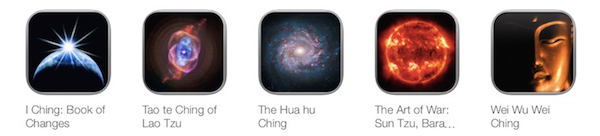
brian browne walker taoist app bundle ios ipad iphone


transcend all phenomena


Arousal,

opinion, excitement,

anger — so easy to spark,

so impossible to govern. Prefer

instead to be impartial, unattached,

empty, silent, still. Staying right

at home, you can transcend

all phenomena and enjoy

complete peace.


Wei wu Wei Ching, Chapter 41

Paperback / Kindle here

iPad/iPhone

iBooks


brian browne walker taoist app bundle ios ipad iphone

You

can now buy

Wei wu Wei Ching as part of a

five-app bundle of Taoist classics 

for iPhone or iPad for less than

the cost of one hardcover

book.


exercise your higher nature

this is how you do it

 
Do not turn your back

when you are needed. The superior

person exercises his higher nature now,

saving not only himself but

others around him.


sixth changing line

Hexagram 39, Chien / Obstruction

The I Ching, or Book of Changes


ebooks & apps of the Tao the Ching, I Ching,

Hua hu Ching, and Art of War for

iPad, Phone, Kindle, Nook,

or Android


You

can now buy

the I Ching as part of a

five-app bundle of Taoist classics 

for iPhone or iPad for less than

the cost of one hardcover

book.

brian browne walker taoist app bundle ios ipad iphone


the mystic develops a wider outlook

like so


While some blame

another for causing him harm,

the wise one first takes

himself to task.


The worldly struggle is outward struggle. The struggle on the spiritual path is inward struggle. No sooner does one take the spiritual direction than the first enemy one meets is one’s own self. What does the self do? It is most mischievous. When one says one wants to fight it, it says, ‘I am yourself. Do you want to fight me?’ And when it brings failure, it is clever enough to put the blame on someone else.

Do all those who have failed in life accuse themselves? No, they always accuse another person. When they have gained something they say, ‘I have done it.’ When they have lost something they say, ‘This person got in my way’. With little and big things, it is all the same. The self does not admit faults; it always puts the blame on others. Its vanity, its pride, its smallness, and its egotistical tendency which is continually active, keep one blind.

By a study of life the Sufi learns and practices the nature of its harmony. He establishes harmony with the self, with others, with the universe and with the infinite. He identifies himself with another, he sees himself, so to speak, in every other being. He cares for neither blame nor praise, considering both as coming from himself.

If a person were to drop a heavy weight and in so doing hurt his own foot, he would not blame his hand for having dropped it, realizing himself in both the hand and the foot. In like manner the Sufi is tolerant when harmed by another, thinking that the harm has come from himself alone.

He overlooks the faults of others, considering that they know no better. He hides the faults of others, and suppresses any facts that would cause disharmony. His constant fight is with the Nafs (the self-centered ego), the root of all disharmony and the only enemy of man.

The mystic develops a wider outlook on life, and this wider outlook changes his actions. He develops a point of view that may be called a divine point of view. Then he rises to the state in which he feels that all that is done to him comes from God, and when he himself does right or wrong, he feels that he does right or wrong to God. To arrive at such a stage is true religion. There can be no better religion than this, the true religion of God on earth. This is the point of view that makes a person God-like and divine. He is resigned when badly treated, but for his own shortcomings, he will take himself to task, for all his actions are directed towards God.


Hazrat Inayat Khan