You come from silence
Return to silence.

Once you
merge your tracks
into the stream of zen,
you spend your days silencing
your mind and studying with your
whole being. You realize that this Great Cause
is not obtained from anyone else but is just a matter
of taking up the task boldly and strongly, and making constant
progress. Day by day you shed your delusions, and day by day you
enhance your clarity of mind. Your potential for enlightened perception
is like fine gold that is to be refined hundreds and thousands of times.
What is essential for getting out of the dusts, what is basic for
helping living creatures, is that you must penetrate
through freely in all directions and arrive at
peace and security free from doubt and
attain the stage of great
potential and great
function.
This work
is located precisely in
your own inner actions. It is just
a matter of being in the midst of the interplay
of the myriad causal conditions every day, in the confusion
of the red dusts, amid favorable and adverse circumstances and
gain and loss, appearing and disappearing in their midst,
without being affected and turned around by
them, but on the contrary, being able
to transform them and turn
them around.
…When you
go on grinding and polishing
like this for a long time, you are liberated
right in the midst of birth and death, and you look upon
the world’s useless reputation and ruinous projects as mere dust
in the wind, as a dream, as a magical apparition, as an
optical illusion. Set free, you pass through the
world. Isn’t this what it means to be a
great saint who has emerged from
the dusts of sensory
attachments?

Enlightenment absorbs this
universe of qualities. When that
merging occurs, there is nothing
but God. This is the only
doctrine.
There is no word for it,
no mind to understand it with,
no categories of transcendence or
non-transcendence, no vow of
silence, no mystical
attitude.
There is no Shiva and
no Shakti in enlightenment,
and if something remains, that
whatever-it-is is the
only teaching.
A lot
of unimportant inner
litter and bits and pieces have
to be swept out first. Even a small head
can be piled high inside with irrelevant distractions.
True, there may be edifying emotions and thoughts, too, but
the clutter is ever present. So let this be the aim of the meditation:
to turn one’s innermost being into a vast empty plain, with none
of that treacherous undergrowth to impede the view. So that
something of “God” can enter you, and something of “Love,”
too. Not the kind of love-de-luxe that you can revel in
deliciously for half an hour, taking pride in
how sublime you feel, but the love
you can apply to small,
everyday things.
…
Looked
at Japanese prints
with Glassner this afternoon.
That’s how I want to write. With that much
space round a few words. They should simply emphasize
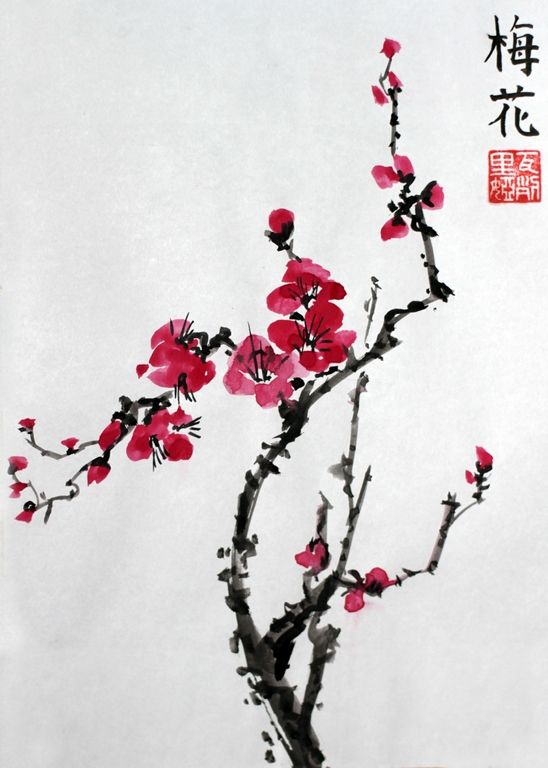
the silence. Just like that print with the sprig of blossom in the
lower corner. A few delicate brush strokes—but with what attention
to the smallest detail—and all around it space, not empty but inspired.
The few great things that matter in life can be said in a few words.
If I should ever write—but what?—I would like to brush in a
few words against a wordless background. To describe
the silence and the stillness and to inspire them.
What matters is the right relationship between
words and wordlessness, the wordlessness
in which much more happens than
in all the words one can
string together.
The mind
can go in a thousand
directions, but on this beautiful
path, I walk in peace. With each step,
the wind blows. With each step,
a flower blooms.