
In the ocean
of the holy dharma there is neither
movement nor stillness. The essence of the wave
is like a mirror; when something comes, the reflection
appears. When there is nothing in the mind,
wind and waves are both
forgotten.
In the ocean
of the holy dharma there is neither
movement nor stillness. The essence of the wave
is like a mirror; when something comes, the reflection
appears. When there is nothing in the mind,
wind and waves are both
forgotten.
A goal may be reached
but only if one’s character is fully aligned
with proper principles. It is always more important
to maintain humility and equanimity than
to satisfy an ambition.
second changing line
The I Ching, or Book of Changes
Hexagram 46, Sheng / Pushing Upward
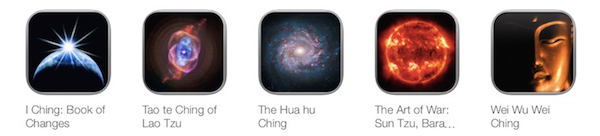
ebooks & apps of the Tao the Ching, I Ching,
Wei wu Wei Ching, Hua hu Ching, and
Art of War for iPad/Phone, Kindle,
You
can now buy
the I Ching as part of a
five-app bundle of Taoist classics
for iPhone or iPad for less than
the cost of one hardcover
book.
To
realize the Way you
must die and stay dead and
go on living. With one mighty blow,
sever the attachments of mind
and self and dwell in
emptiness.
Pouring
emptiness into emptiness
like waves coming to shore,
you become quiet,
luminous,
still.
Where
before there were
ten thousand entanglements, now
there is undifferentiated
Oneness, clarity,
peace.
i ching / hexagram 3 ☯️ difficulty at the beginning
You
can now buy
Wei wu Wei Ching as part of a
five-app bundle of Taoist classics
for iPhone or iPad for less than
the cost of one hardcover
book.

Want
to study with
an enlightened teacher?
Just stop giving rise to thoughts
and divisions and distinctions. When
self and other, good and bad, right
and wrong are replaced with
emptiness, you are your
own master.
🪷
i ching hexagram 4 / meng (youthful folly)
🪷
You
can now buy
Wei wu Wei Ching as part of a
five-app bundle of Taoist classics
for iPhone or iPad for less than
the cost of one hardcover
book.
All the myriad things are neither opposed to nor contrary to your true self. Directly pass through to freedom and they make one whole. It has been this way from time without beginning.
The only problem is when people put themselves in opposition to it and spurn it and impose orientations of grasping or rejecting, creating a concern where there is none. This is precisely why they are not joyfully alive.
If you can cut off outward clinging to objects and inwardly forget your false ideas of self, things themselves are the true self, and the true self itself is things: things and true self are one suchness, opening through to infinity…
Time and again I see longtime Zen students who have been freezing their spirits and letting their perception settle out and clarify for a long time. Though they have entered the Way, they immediately accepted a single device or a single state, and now they rigidly hold to it and won’t allow it to be stripped away. This is truly a serious disease.
To succeed it is necessary to melt and let go and spontaneously attain a state of great rest.

