
all good comes when we are innocent

kirvan baldassari


In the

very center of each

of us there dwells an innocent

and divine spirit. If we allow ourselves to

be guided by it in every situation, we can never

go wrong. Wu Wang comes to remind us that

we must actively disengage our egos

before we can obtain the vast

rewards that come from

living in a state of

innocence.


The nature

of the ego is that when

we exercise it, it takes us out

of the present. When we engage in

ambitions, anxieties, or anticipations,

our ego is skipping ahead, and we miss the

guidance of the Creative in the present moment.

When we engage in anger, judgment, and condemnation —

whether toward ourselves or others — our ego is looking

backward, and we cannot see the Sage’s clear solution

to the present situation. In either case, the result is

misfortune. Only by stilling the ego and accepting

life in its entirety can we become innocent.

In this state we are receptive to the

help of the Higher Power and

can meet with good fortune

wherever we go.


You are

advised now to stop

looking forward and backward,

to abandon your ambitions, to disengage

from judgments and critical thinking. If a thought,

attitude, or action is not in accord with the principles of

acceptance, equanimity, humility, and gentleness,

do not indulge in it. The I Ching encourages you

to actively practice innocence. Because

the  ego is strong, you must make a

conscious and conscientious

effort to be innocent.


If you

willfully unstructure

your attitude, open your heart

to the Deity, and allow yourself to be

guided by that which is innocent

and pure, you will meet with

success in the coming

time.


The I Ching, or Book of Changes

Hexagram 25, Wu Wang / Innocence (The Unexpected)

ebooks & apps of the Tao the Ching, I Ching,

Hua hu Ching, and Art of War for

iPad, Phone, Kindle, Nook,

or Android


You

can now buy

Tao te Ching as part of a

five-app bundle of Taoist classics 

for iPhone or iPad for less than

the cost of one hardcover

book.
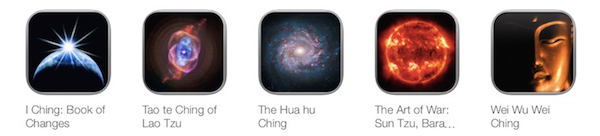
brian browne walker taoist app bundle ios ipad iphone


the proper conduct of relationships

majeed badizadegan


In relationships,

desires lead to misfortune.

Behave with discipline

and balance.


Kuei Mei is concerned with the guidelines for the proper conduct of relationships, whether they be social, romantic, or work related. The image here is of thunder roiling the surface of a lake, and it suggests that relationships can be disturbing to our peace of mind unless they are established and governed under proper principles.

The nature of relationships is that they lead us into the desire state: we begin to desire another, desire recognition, desire retribution, desire a particular outcome in a given situation. All of these desires lead us away from the equanimity that we aim to maintain as students of the I Ching. This hexagram often comes as a sign that you are in danger of sacrificing your composure in an effort to affect a relationship.

When someone does not treat you as you would like, you are faced with a choice as to what to do. While it may be tempting to abandon the relationship in anger or act aggressively to produce a result, neither of these is consistent with proper principles.

You are counseled instead to return to inner independence, acceptance, modestly, and gentleness. The greatest influence is always had through inner discipline and balance; less subtle measures may produce more immediate results, but they are seldom lasting.

This hexagram also teaches us that rushing into a relationship, rushing to resolve a relationship, or rushing to escape a relationship are all akin to rushing on ice: each invites a panful fall. Seek to establish relationships slowly and on proper principles, to allow them to evolve naturally, and to resolve disputes with patience and reserve.

If your primary relationship — that with the Sage — is open and ongoing and devoted, then all other relationships will fall into place.


The I Ching, or Book of Changes

Hexagram 54, Kuei Mei / The Marrying Maiden


Wei wu Wei Ching 54  ☯️  returning to innocence


ebooks & apps of the Tao the Ching, I Ching,

Wei wu Wei Ching, Hua hu Ching, and

Art of War for iPad/Phone, Kindle,

Nook, or Android


You

can now buy

the I Ching as part of a

five-app bundle of Taoist classics 

for iPhone or iPad for less than

the cost of one hardcover

book.

brian browne walker taoist app bundle ios ipad iphone


quiet strength insures success

joel rea


An

unavoidable time of adversity.

 Quiet strength insures a

later success.


It is a time

of oppression and exhaustion.

None of us escapes such moments; they are simply

a part of living. By meeting them in the correct spirit and

cheerfully bending instead of breaking, you weather

the adversity and meet with success

at a later time.


Inferior elements,

either in one’s self, another,

or the larger world, interfere now to

restrain the superior person. It is foolish to fight

against the restraint; success is simply not possible now.

Rid yourself of the desire to progress and return

to neutrality and acceptance. The stubborn

pursuit of results will bring

misfortune.


With others,

quietness and equanimity are

the watchwords of the moment. Say little,

and say it gently. A similar reticence and gentleness

should be applied to yourself. Do not lapse into

impatience or mistrust of the Deity. Accept

that the Creative often works in a way

that we cannot see or

understand.


A feeling of

despair or depression is a sign

that you are holding a false belief.

To perpetuate an untruth about yourself,

another, or the Sage is to block your own

happiness. Root out and remove any

idea or attitude which

causes negative

feelings.


By opening

your mind, quieting your heart,

and calmly holding to proper principles,

you make it possible for the Creative

to eliminate the oppression

that currently

exists.


from The I Ching, or Book of Changes

Hexagram 47, K’un / Oppression (Exhaustion)


ebooks & apps of the Tao the Ching, I Ching,

Hua hu Ching, and Art of War for

iPad, Phone, Kindle, Nook,

or Android


You

can now buy

the I Ching as part of a

five-app bundle of Taoist classics 

for iPhone or iPad for less than

the cost of one hardcover

book.

brian browne walker taoist app bundle ios ipad iphone


an object of esteem becomes a nest

giuseppe palmisano

 
Haven’t you seen the saying of Master Yantou that whenever you have an object of esteem, it becomes a nest?…

Those who get a taste for the sayings of people of old make extraordinary sayings and wonderful statements into a nest…Those who get a taste for a state of quiescent silence without words or speech make a nest of closing the eyes and sitting in a ghost cave in a mountain of darkness on the other side of the prehistoric Buddhas. Those who get a taste for the goings-on of daily activities make a nest of raising their eyebrows, blinking their eyes, and alerting attention…

If you do not have a strong will and discipline to step back and realize your error, you will imagine what you esteem to be extraordinary, imagine it to be mysterious and marvelous, imagine it to be peace and security, imagine it to be ultimate, imagine it to be liberation.

Those who entertain such imaginations could not be helped even if the Buddha appeared in the world. In the teachings this is called the confusion of ignorance and benightedness. Why? because you are ignorant you cling to error and consider it right. Because you are benighted you remain plunged into what you esteem and cannot budge.

If you do not produce anything in your mind, and are not fixated on anything, then you have no object of esteem. When you have no object of esteem, you naturally have no greed and no dependence on things, independent in the midst of things, with bare-boned strength. 

If you want such accord right now, it is not difficult; just be equanimous in mind, unaffected by anything. What is affectation? Formulating concepts of sentient beings, concepts of Buddha, concepts of the mundane, concepts of the transcendental, concepts of seeking detachment, concepts of seeking enlightened knowledge. Those are all called affectations.

Just concentrate intensely on the brink of arousal, and leap out in one jump — this mind will be clear, independently liberated. Then as soon as you sense this, turn upward, and you will spontaneously be lucid everywhere; it will be evident in everything. 

When you manage to reach such a state, don’t keep taking note of it. If you keep taking note of it, then you’ll have an object of esteem.
 

Dahui

treasury of the eye of true teaching