
Don’t
love sagehood;
sagehood is an empty name.
There is no special truth but this radiant
spiritual openness, unobstructed
and free. It is not attained by
adornment and cultivated
realization.
Don’t
love sagehood;
sagehood is an empty name.
There is no special truth but this radiant
spiritual openness, unobstructed
and free. It is not attained by
adornment and cultivated
realization.
When you are completely
absorbed in your breathing, there is no self.
What is your breathing? That breathing is not you, nor air.
What is it? It is not self at all. When there is no self,
you have absolute freedom. Because you have
a silly idea of self, you have
a lot of problems.
To Shine One Corner of the World

Dogen Zen-ji says,
“Even though it is midnight, dawn is here.
Even though dawn comes, it is nighttime.” This kind
of statement conveys the understanding transmitted from
Buddha to the Patriarchs, and from the Patriarchs to Dogen,
and to us. Nighttime and daytime are not different.
The same thing is sometimes called nighttime,
sometimes called daytime. Nighttime
and daytime are one thing.
Zazen practice and
everyday activity are one thing.
We call zazen everyday life, and everyday life zazen.
But usually we think, “Now zazen is over, and now we
will go about our everyday activity.” But this is not the
right understanding. They are the same thing. We
have nowhere to escape. So in activity there
should be calmness, and in calmness
there should be activity. So
calmness and activity
are not different.

With greatest respect and reverence, I encourage all you superior seekers in the secret depths to devote yourselves to penetrating and clarifying the self as earnestly as you would put out a fire on the top of your head. I urge you to keep boring your way through as assiduously as you would seek a lost article of incalculable worth.
I enjoin you to regard the teachings left by the Buddha-patriarchs with the same spirit of hostility you would show toward a person who had murdered both your parents. Anyone who belongs to the school of Zen and does not engage in the doubting and introspection of koan must be considered a deadbeat rascal of the lowest kind, someone who would throw aside his greatest asset. As a teacher of the past said, “At the bottom of great doubt lies great enlightenment … From a full measure of doubt comes a full measure of enlightenment.”
Don’t think the commitments and pressing duties of secular life leave you no time to go about forming a ball of doubt. Don’t think your mind is so crowded with confused thoughts you are incapable of devoting yourself singlemindedly to Zen practice. Suppose a man was in a busy market place, pushing his way through the dense crowd, and some gold coins dropped out of his pocket into the dirt. Do you think he would just leave them there forget about them and continue on his way because of where he was?
Do you think someone would leave the gold pieces behind because he was in a crowded place or because the coins were lying in the dirt? Of course not. He would be down there frantically pushing and shoving with tears in his eyes trying to find them. His mind wouldn’t rest until he had recovered them. Yet what are a few pieces of gold when set against that priceless jewel found in the headdresses of kings — the way of inconceivable being that exists within your own mind? Could a jewel of such worth be attained easily, without effort?
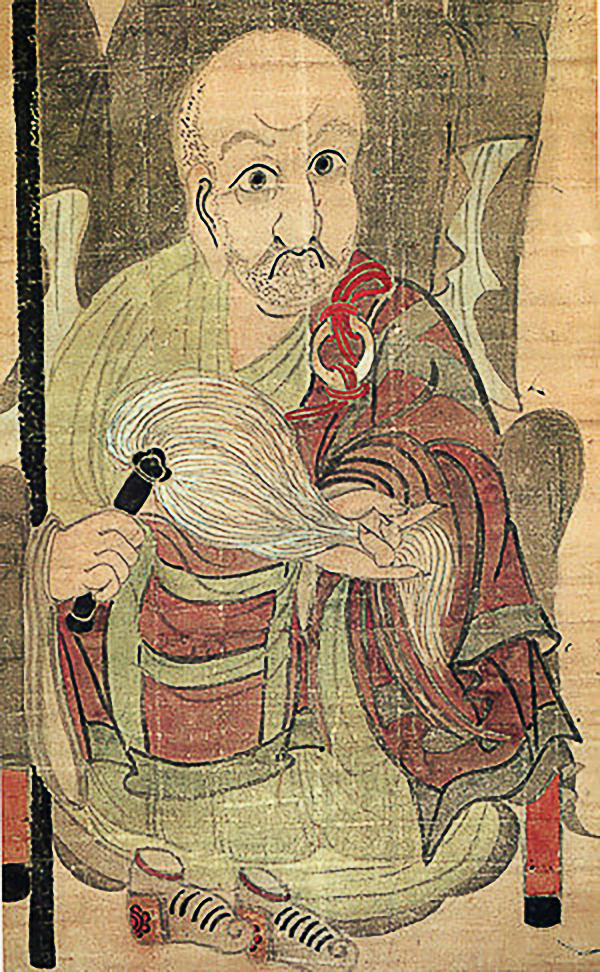
a brief biography of hakuin ekaku
One part of
“the real aspect of things,”
one part each of “the self and all things”
and “the realization that these are false,” three parts
of “the immediate realization of nirvana”, two parts of
“without desires,” two or three parts of “the non-duality of
activity and quietude,” one and a half parts of sponge-gourd skin
and one part of “the discarding of all delusion”. Steep these
ingredients in the juice of patience for one night, dry in
the shade and then mash. Season with a dash of
prajna-paramita, then shape everything
into a ball the size of a duck’s egg
and set it securely on
your head.