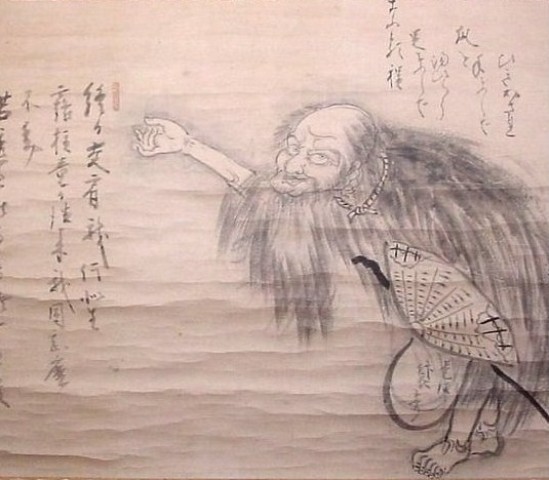
stilted koans are all monks have
Ikkyü also had a hermitage in Kyoto which he called Katsuroan (Blind Donkey Hermitage), and often stayed at Daitokuji. But increasingly, to the point of anguish, he became disgusted with worldly carryings on at the main temple, shuddering at the…frantic hustling for donations:
Yoso hangs up ladles baskets useless donations in the temple
my style’s a straw raincoat strolls by rivers and lakes
*
ten fussy days running this temple all red tape
look me up if you want to in the bar whorehouse fish market
In 1471, when seventy-seven, Ikkyü revealed his passion for a blind girl, an attendant at the Shuon’an Temple at Takigi. He wrote poems about their affair, some farcical, some very moving. He was self-conscious at the oddness of an old zen monk falling for a young woman, but they spent years together, Ikkyü’s feeling for her growing in intensity:
I love taking my new girl blind Mori on a spring picnic
I love seeing her exquisite free face its moist sexual heat shine
*
your name Mori means forest like the infinite fresh
green distances of your blindness
*
I was like an old leafless tree until we met green buds burst and blossom
now that I have you I’ll never forget what I owe you
poems translated by stephen berg in crow with no mouth
prose introduction by lucien stryk