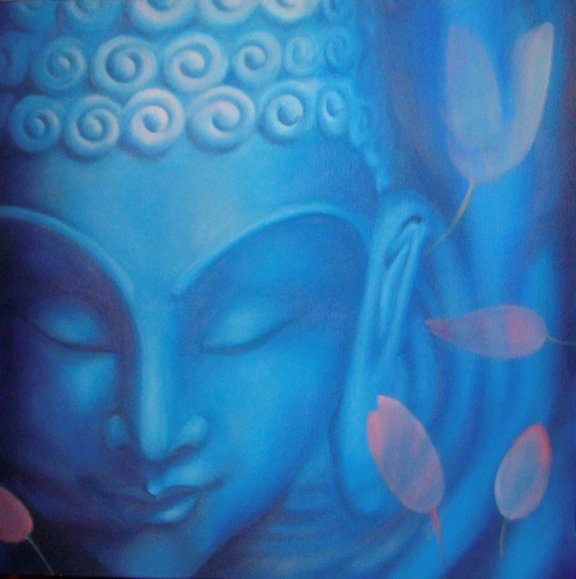
a truly good person


A truly

good person doesn’t

dwell on her goodness.

Thus she can be good.

A person of false goodness

never forgets her goodness.

Thus her goodness is

always false.


A truly

good person does nothing,

yet nothing remains undone.

A person of false goodness is forever

doing, yet everything remains

forever undone.


Those who

are interested in service

act without motive. Those who are

interested in righteousness act with

motives of all sorts. Those who are

interested in propriety act, and

receiving no response, they

roll up their sleeves

and use force.


When

Tao is lost,

goodness appears.

When goodness is lost,

philanthropy appears.

When philanthropy is lost,

justice appears.

When justice is lost,

only etiquette

is left.


Etiquette

is the faintest husk

of real loyalty and faith,

and it is the beginning of confusion.

Knowledge of the future is only

a blossom of Tao; to become

preoccupied with it

is folly.


Thus the

sage sets her sights

on the substance and not the

surface, on the fruit and not the

flower. Leaving the one,

she gains the

other.


from The Tao te Ching of Lao Tzu,

Chapter 38


ebooks & apps of the Tao the Ching, I Ching,

Hua hu Ching, and Art of War for

iPad, Phone, Kindle, Nook,

or Android


You

can now buy

Tao te Ching as part of a

five-app bundle of Taoist classics 

for iPhone or iPad for less than

the cost of one hardcover

book.

brian browne walker taoist app bundle ios ipad iphone


add to goodness from your own heart

the way of jesus


Whenever we see

that goodness is lacking,

we may add to it from our own heart

and so complete the nobility of human nature.

This is done by patience, tolerance, kindness, forgiveness.

The lover of goodness loves every little sign of goodness.

He overlooks the faults and fills up the gaps by

pouring out love and supplying that

which is lacking. This is real

nobility of soul.


Hazrat Inayat Khan

the stream of love


a time for disengagement and retreat

just be still


This is a time for

disengagement and retreat.

In stillness you are out

of the reach of

danger.


It is inherent in the design of life that forces of darkness and disruption come into prominence from time to time. This hexagram indicates that this is such a time and advises you to respond by quietly retreating. To struggle or resist in anger now is to add fuel to the fire of negativity which threatens to consume you.

The superior person accepts that there is a natural ebb and flow between the forces of light and dark in the world. Wisdom lies not in resisting these movements but in responding to them appropriately. Just as a plant which sprouts in the dead of winter is doomed, and one which sprouts in spring flourishes, so it is with us. Success and prosperity accrue to those who advance in times of light and retreat in times of darkness. To retreat now is to benefit, in the end, from the changing tides.

Retreat is not the same thing as surrender, capitulation, or abandonment, which are desperate and unsatisfying measures. Neither is it characterized by a hardening into angry or punitive emotions. It is instead an acceptance and a choice: we calmly accept that the energies of the moment are against us, and we wisely choose to withdraw into the safety of stillness. In this dignified and balanced manner we protect ourselves from negative influences and arrive rested in a more beneficial hour.
 

from The I Ching, or Book of Changes

Hexagram 33, Tun / Retreat


ebooks & apps of the Tao the Ching, I Ching,

Wei wu Wei Ching, Hua hu Ching, and

Art of War for iPad/Phone, Kindle,

Nook, or Android


You

can now buy

the I Ching as part of a

five-app bundle of Taoist classics 

for iPhone or iPad for less than

the cost of one hardcover

book.
brian browne walker taoist app bundle ios ipad iphone


the benefit of engagement in politics

only love can do that


Forget the self and you’ll help others.

Deshan Xuanjian


The spiritual benefit of engagement in politics comes from going into rather than away from the imperfection. And if you are diving right into the heart of delusion, naturally this means into the heart of your own delusion. There’s always a chance that such a plunge might increase self-knowledge more than it increases self-righteousness.

The point here is that you have to forget all that spiritual stuff about what a good person you are or intend to be someday, something that is anyway unlikely to be attained. The spirituality in politics might not be visible to others or even to yourself. Down there in the heart of delusion you look like a demon too, just like the rest of us. You’ll have to adapt your fashion sense to having horns and fangs.

This is the force of Bismarck’s famous comment about the art of the possible: in order to bring about any sort of transformation you have to work with what is actually the case, rather than what you might have wished for or pretended — in the world, in others, in yourself.

When I accepted how the world is, I noticed that empathy is part of how it is. It’s not easy to explain; it doesn’t have a reason. Empathy seems to be a basis for spiritual work — for the bodhisattva way. Empathy also doesn’t seem to be entirely personal. We didn’t work for change because we liked each other or the people who might benefit; there was empathy even when people were behaving in ways that I might find painful.


John Tarrant

bring me the rhinoceros