If you live on the breath,
you won’t be tortured by hunger and
thirst, or the longing to touch. The purpose of
being born is fulfilled in the state
between “I am” and
“That”.
If you live on the breath,
you won’t be tortured by hunger and
thirst, or the longing to touch. The purpose of
being born is fulfilled in the state
between “I am” and
“That”.

The Fifth Ancestor
Daimin Konin wanted to find
his successor. He asked the monks to write
a poem to express their understanding. Jinshu,
the headmonk, wrote the following poem
on the wall in the middle
of the night:
Our body is the bodhi tree,
our mind a mirror bright.
Carefully wipe then hour by hour,
and let no dust alight.
When Eno saw this
next day, he said to the monk
standing next to him, “I too have a poem.
Since I am illiterate, would you
write it down for me?”
There is no bodhi tree,
nor stand of a mirror bright.
Since all is void,
where can the dust alight?
When Konin saw this, he
knew the author had the understanding
he was looking for, and he recognized Eno as
his dharma heir and hence the
Sixth Ancestor.
branching streams flow in the darkness
The ancients were
those who gave up all
learning and mastered
the wu wei idleness
of tao.
Soul guides and
prophets have an innate innocence,
but they are subject to the same consequences
as everyone. If a donkey veers off course, he will be hit
with a stick. If you do wrong, you will be punished. Abu Bakr
said that steadiness is the central virtue. From the
mind’s steadiness comes a right action
which in turn balances the
intelligence.
They asked me
why prophets were given hardships.
I said it helps to have clear indications. And I added
silently to myself, Be more humble like someone
held captive. Bow to the one who
can free you.

You serve
as an example to others by
sacrificing your ego and accepting
the guidance of the Higher
Power.
The hexagram
Ting concerns the nourishment
and guidance one must have in order to fully
succeed. While the culture around us often encourages
us to “take charge” and make aggressive demands on life, the
I Ching offers far wiser counsel. Here we are encouraged
to give up the incessant demands of our ego —
to deepen our humility and acceptance
and to listen carefully to the
instructions of the
Sage.
The image
of the caldron concerns
your inner thoughts: whatever you hold
in the “caldron” of your mind is your offering
to the Higher Power. The quality of assistance you can
receive from the universe is governed by the quality of your
offering. If you constantly indulge in the concerns of the ego —
fears, desires, strategies to control, harshness toward others —
you repel the Higher Power and block your own nourishment.
If, on the other hand, you consciously let go of your
resistance to life and hold quiet and correct
thoughts, you become receptive to the
Creative and your continual
nourishment is
assured.
Ting comes
to suggest that the wisest
thing that you can do now is to still
your ego and conscientiously enter into a
conversation with the Sage. To influence others, or to
achieve a proper goal, follow the same path. By cultivating
humility and acceptance, purifying your inner thoughts,
and concentrating on that which is good and innocent
and true, you summon the power of the Creative
and meet with good fortune in
the outer world.
from The I Ching, or Book of Changes
Hexagram 50, Ting / The Caldron
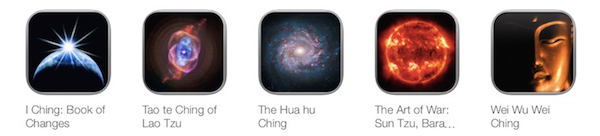
ebooks & apps of the Tao the Ching, I Ching,
Hua hu Ching, and Art of War for
You
can now buy
the I Ching as part of a
five-app bundle of Taoist classics
for iPhone or iPad for less than
the cost of one hardcover
book.